I tell people that “poetry saved my life.” And it is true. I grew up female and artistically inclined in a small, conservative town just off I-35, halfway between Wichita and Kansas City. We had more churches, guns, and cows than schools, and I found escape in poetry and piano. When I started public school in second grade, I discovered the restricted section of the library and began smuggling books out to the playground. In my haste and secrecy, I had to choose books by smell, shape, and size. Each one was a surprise.
The first book I remember taking was an anthology of “Modern Poetry.” And reading it, I fell in love with poetry on a rusty swing set. It was a poem by Edwin Arlington Robinson that did it: “Dark Hills at Evening in the West.” I was seven. I did not understand it. I had not been to war or yet buried anyone I loved, but I recognized the ache, resonated with Robinson’s cadence of hope and regret, delighted at the tumble of his words on my tongue: “where sunset hovers like the sound / of golden horns that sang to rest / old bones of warriors underground.”
I am 48 now, with children and an unrestricted library of my own, but I still feel a connection to that poem. Poetry, reading it, writing it, was/is how I found/find order in the world—assigning metrical, sonic, and metaphorical value to experiences I could not/cannot yet speak about out loud—generational poverty, violence, religious fundamentalism, suicide, sexual abuse, and love—so much love.
When I taught my first poetry class, I brought my beloved book of poems and shared it with my students. I invited them to smell it. To feel the soft rub of its pages. I shared with them my story. I recited for them the poem that started my journey. They passed it around and tolerated my nostalgic moment with relatively few eye rolls and sighs. But when I went to collect my book at the end of class, I could not find it. I looked everywhere. I felt gutted. I felt angry. Someone had stolen my book!
Then it hit me: someone had stolen my book. I’ve never taught a more successful class.
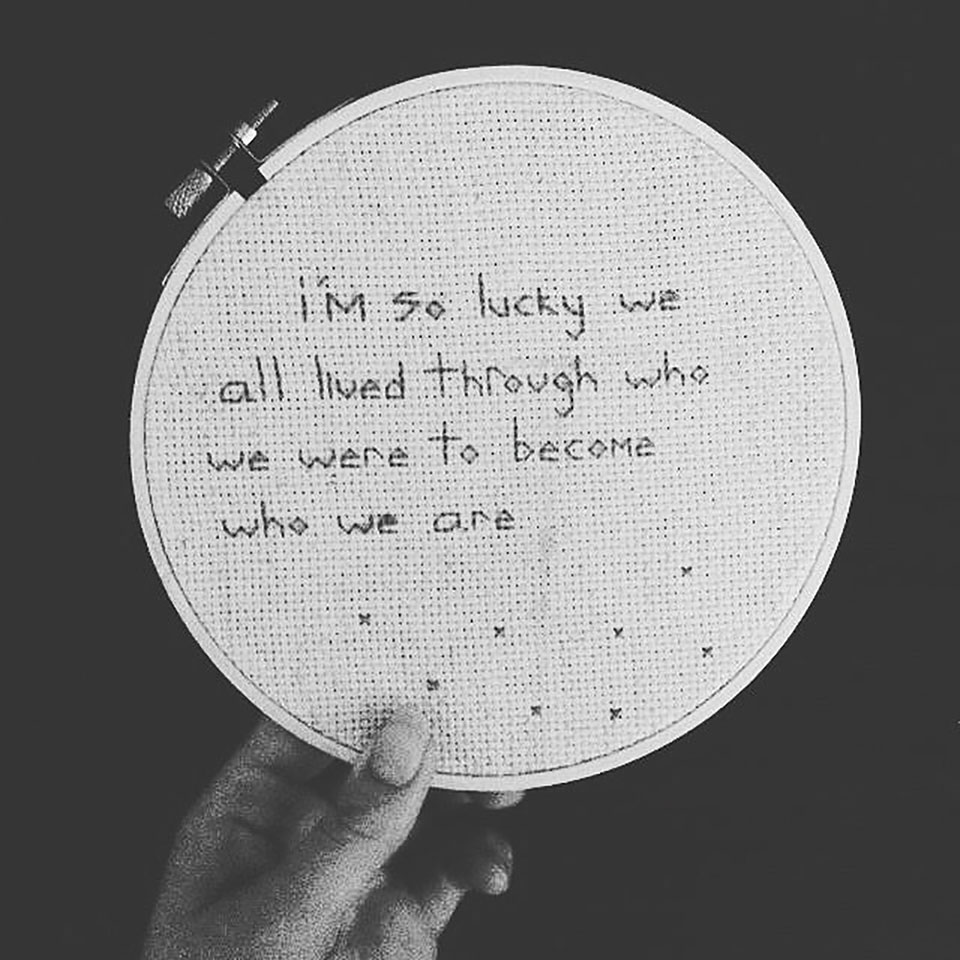
(Creative cross-stitch by Tiffany Marie inspired by Button poet Neil Hilborn’s “Our Numbered Days”)


So. Much. Love.
Sent from Yahoo Mail for iPhone
LikeLike